Tuesday, January 09, 2007

Reflections in Water


Here is a rule that comes in handy when painting reflections on the water. Light objects reflect darker and dark objects make a reflection that is lighter. As you can see from this photo, the white boat casts a darker reflection in the water and the dark motor reflects lighter in the water. Don't ask me why but its always that way.
I have made an 11 minute video on the subject of waves and water. Click here
You can see a list of my other videos HERE.

Friday, January 05, 2007

Pitfalls of using photographs by others

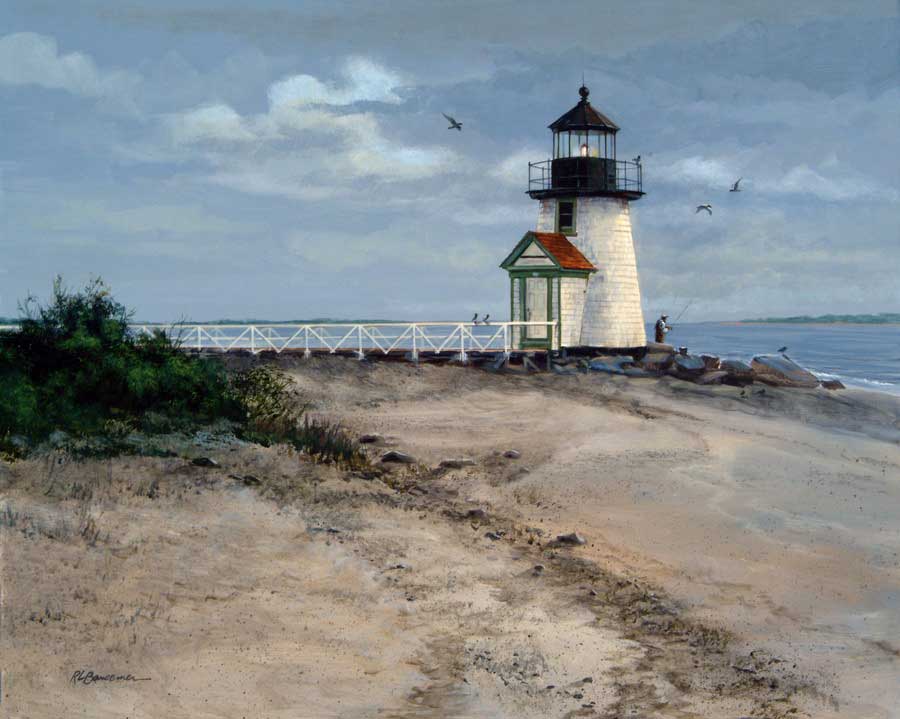
The painting (above) was done using photograhs that I didn't take. I seldom resort to that but occassionally there is no option but doing so poses certain problems. Not because of a lawsuit as my painting ends up far from being close to the photograph. The problem comes with lack of information even with a good photo seems to provide. Here is an example.
The first picture (below) shows the rocks but gave me no indication of where they jutted in and out. I assumed they didn't have much direction at all. I started the painting using the first photo and then found this second photo which defined the crevises with light and shadow more clearly. Had I actually been at the lighthouse (wish I could) even for a minute I would have grasped and understood the topography that the first photo simply didn't express.
So, even if you work from photographs, doing so from your own photos will result in a much clearer undertsanding of what you are trying to portray. It only takes a moment for those important features to stick in your mind when you take your own pictures.

Keeping your acrylics from drying out


As I'm sure you know, acrylics dry quickly. Sometimes too quickly. Your half hour break for lunch will find a palette full of unusable dry paint when you return. A simple box (I built mine with a clear acrylic top) will keep your paints wet even overnight. Just give the top of the lid as well as the paints a squirt of water from a spray bottle when covering your paints.

Another commercial method to keep paints wet is to purchase "Masterson's Sta-Wet Palette". With this you use the wet sponge and a special paper palette. It will keep acrylic paints very wet for many days.

Thursday, January 04, 2007

More than paint on canvas


Painting a landscape is not about putting paint on canvas, it is the process of continually and attentively absorbing the visual world with a caring eye in a way that others take for granted.

Friday, December 29, 2006

See more, express less

A good artist will see more and express less. Therein lies the power of a good painting. A complex landscape in the country has thousands of elements to consider; trees, limbs, leaves, grass, clouds, shadows, colors, values, and on and on. The artist takes this myriad of overwhelming information and expresses it clearly in simple terms so it can be more fully grasped in its essence.

Web sites and your artwork


The only way I know to sell your paintings or prints on the internet is to have a niche market for your work. I paint many different subjects. In the summer when I'm in my studio in the North Carolina I do landscapes of the Blue Ridge mountains, barns, etc. The problem is that no one knows how to look for such a thing on the web because it's such a broad subject. Now if I were to feature paintings of Mount Mitchell and someone was trying to find a painting of Mount Mitchell, then a search would be able to find my niche. Otherwise it's lost in a sea of general ties.
I've done two books on lighthouses and just by accident, I found a niche market for lighthouse prints. The important thing to know is that people who order lighthouse prints are not interested in buying a print of a lighthouse. They are interested in buying a print of a particular lighthouse because it has personal meaning to them. Any lighthouse won't do. On my website www.bansemer.com I feature lighthouses and when someone is looking for a print of the "Morris Island Lighthouse", well, I just happen to have it and it's easy to find. It's the only way I know of so far to be successful on the web. I suppose there might be a niche for "fantasy lighthouses" as well. In any case, generalities don't work well if you are trying to promote your work. Be specific.
(Pictured is a painting I did of the Brandt Point lighthouse in Nantucket)

Hesitation makes for weak paintings

You can be sure that a painting that inspires us was done by an artist sure of him/herself and not one that hesitates. Most good paintings display brushstrokes that are deliberate, strong, and know where they are going. It is a very difficult thing to do. Study those who have mastered it and see how much they convey in a powerful and well placed stroke.

Wednesday, November 29, 2006

Seascape Painting


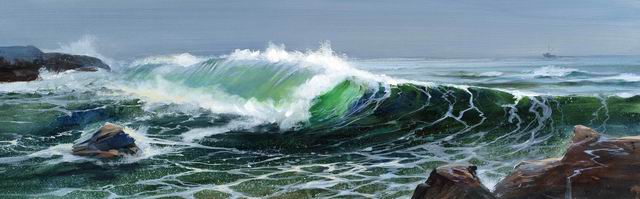
The painting of most subjects can be learned by looking at subject itself. One exception is the painting of seascapes. That can often be learned best by looking at someones work who paints seascapes well rather than sitting and looking at real waves crashing on the beach.

Getting Results

Don't be overly concerned with the results of your painting. After all, it is just paint on canvas. Move on to the next one and the mistakes you have made combined with what you have learned making those mistakes will serve to make your next work a little better. Laboring over a painting by trying push it to the point you know you would like to see it is often a futile excercise and can worsen your final results. We all have limits from which we cannot exceed. If you have a general idea where those limits are and not beat yourself up over not reaching them every time, your progress will be natural and steady.

Tuesday, November 28, 2006

Playing up the Important


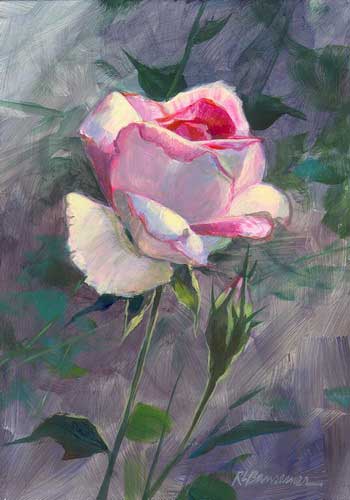
When everything is bright, then nothing is bright. If you want something to demand attention, make whatever is around it less important like the background behind this small flower painting.

Field Studies

I have seen artists paint on location and use it as reference for a larger more finished work to be done at their studio and tell others how important that procedure is. I have never been able to grasp that concept. When I paint outside, I am never able to finish the painting on location and I never use it as reference to do a larger piece. After painting outside, I finish a painting in the studio and leave it at that, then I have a nicely finished small painting to show rather than leaving it as a study. To create a larger painting I need more information than I'm able to glean during the half hour I painted outside. The idea of painting less and making more of it later just doesn't work for me. My field paintings are simplified and basic and seldom can I transfer that to a larger piece. It doesn't mean that plein air painting is of no value. The soul of the subject can often be felt while in the field as opposed to being in the studio. That information can be mindfully stored and often comes out naturally in future paintings. I require information to complete a larger painting and I use a camera to capture the details I need for a large work, not just a small field study.

Monday, November 27, 2006

Thoughts on Essence

All my life I have heard artists say that they want to capture the essence of the subject. It is one of those phrases that sounds good and makes the artist feel like they have insights into things that others don't.
So, I've been thinking about it lately (now that I'm nearing my late 50's) and I have on occassion captured the essence of my subject. When it happens I know it but it wasn't something I could force. The more times it has happened, the closer I have become to knowing what it means to me.
Artists must pick and choose what they want to focus on in a painting. Whatever that is becomes the center of interest. all else becomes subservient and takes on a suporting role. It is the difference between a painting and a photograph. The camera, at leasts for most of us, can't capture the essence as it sees all things equally. A good artist, however, transforms the landscape into important and unimportant features that all work together. Those who paint every blade of grass thinking they are capturing nature cannot possibly capture the essence of the subject. It may take lots of time but takes little skill to paint every detail equally. Essence is achieved when one captures an entire field of grass with a few strokes of the brush and gets the feeling of vastness, richness, depth, and light. If those few strokes convey those things they have captured the essence of the subject. Essence is the ability to take the complex, reduce it to the minimum but within that minimum reveal more than the combination of all those blades of grass put together.

Tuesday, November 21, 2006

Connections

You can know everything there is about painting and still not know how to paint. There is a link between your head and heart and your hand. Those elements must be closely connected. All your knowledge of painting has to be transferred from your knowledge and emotions to your hand and brush. That almost mystical communication just comes with time and cannot be accomplished by intellect alone no matter whether your a plumber, doctor, or an artist.

Learning Curve

I have found that my ability in painting does not increase in an upward curve. Rather it runs in a straight line for months at a time, sometimes longer and then suddenly jumps to the next level quite by surprise. For me, reaching the next step on the ladder comes not by trying to hurry to that next wrung but instead by slowly and steadily working my way upward. Trying to force it often will cause frustration and possibly a fall. I enjoy the level I'm at, enjoy the moment and when I reach another step, it becomes an unexpected and rewarding experience. Once that next level is reached it will always be with you.

Complexity


The complexity in nature is overwhelming when looking at a subject weather it be a landscape, seascape, portrait, or whatever it may be but the beauty and joy of painting is taking that vast amount of complexity and reducing it to a few simple brush strokes. That is what is meant by capturing the essence of the subject and it's a true joy when this can be accomplished.

Saturday, November 11, 2006

Kitchen counters

Artists need to know that a Corian kitchen counter is more important than an original piece of art for all but a very small fraction of homeowners.

Saturday, November 04, 2006

George Inness

American Landscape Painter George Inness (1825-1894) wrote: "A work of art must have subtlety of tone and a certain amount of mystery that can never be seen at first glance. It must be looked at a long time before its subtle tones can be grasped; and if it is great, it grows upon you, and the longer you look, the more you see, and to describe it is almost impossible, because you never see it twice a like. It changes with your mood. It is a thing to live with. You study it; you learn to see the soul of it. It is like a face that becomes beautiful because you have learned to know and love the soul behind it. When a picture gives you this effect, it is great art."
What a beautiful statement!

Be Skeptical

A landscape painting can make such a beautiful and powerful statement on its own without entering that realm of opinions and personal points of view. Be skeptical of "truths" when it comes to rights and wrongs of art. Find that truth in looking at nature.

Looking at Art

Looking at artwork that is not up to your standards or not as good as you can produce yourself is generally a waste of time. It can force you to find merit in work that you may otherwise just overlook but other than that, time is better spent looking at nature. When I visit to a gallery I want to leave saying to myself, "Wow, I wish I could paint like that." If that doesn't happen nothing much has been accomplished.

Friday, November 03, 2006

Our Slogan Is....

There are election posters littering the streets when I wrote this and one large sign had a photo of the smiling candidate along with the slogan "We Can Do It". A simple minded slogan and apparently a platform with no meaning whatsoever. Well, in painting the public is "sold" the same thing, trite pictures with no meaning or substance by heavily promoted artists producing primarily for the salability. It seems to be the easy way to go and pleases everyone. Eye candy with no meat. Don't think that anything short of giving your paintings as much meaning and thought as possible will give you any lasting satisfaction. Your paintings need a real platform that speak more than mere slogan. Don't paint pretty pictures for the sake of painting a pretty picture.